This is Paper C of the C09 note on UAV and drone ground control station backup power, and it covers the testing and certification work that proves a pack is safe and durable before it is delivered. The honest boundary from the earlier papers still holds: the station's internal battery is lithium-ion or lithium-polymer, and sealed nickel-metal hydride is the support-layer chemistry used in rechargeable operator training packs, garrison and multi-bay chargers and docks, AA/AAA-compatible accessories and legacy gear, and dock and solar-gateway buffers. The qualification task here is to demonstrate that those nickel packs survive the same field environment the station and its peripherals do, hold their performance across the published standards, and ship under the correct transport rules. This paper works through the environmental and electromagnetic methods, the vehicle power transient standard, the ingress rating, the nickel-specific safety and performance standards, and the land, sea and air transport path, keeping every requirement traceable to the named standard rather than to a generic claim. The binding values for a real project remain the device manual and the agreed pack drawing.
Key fact 1. Environmental durability is demonstrated under MIL-STD-810, which tailors methods such as shock, vibration, temperature and humidity to the actual mission profile rather than applying every method blindly. Ingress is separately rated under IEC 60529, and equipment-level EMI is controlled under MIL-STD-461.
Key fact 2. Vehicle-mounted support equipment has to survive the harsh 28-volt vehicle bus under MIL-STD-1275, which defines the cranking collapse, surges and spikes the connected equipment must operate through; published reference designs show the two-stage clamping and reverse-polarity protection that meet the transient envelope.
Key fact 3. Nickel safety and performance are governed by the nickel standards, not the lithium ones. Sealed cells are qualified to IEC 61951-2 for performance and IEC 62133-1 for safety, with IEC 61959 for mechanical safety and IEC 63115-2 for industrial cells, and nickel packs do not use the lithium transport tests.
Key fact 4. Transport is the not-restricted nickel path. Sealed nickel packs ship under UN 3496 as a Class 9 miscellaneous entry for land transport, with the IATA A199 provision giving the not-restricted air path and the corresponding IMDG and ADR rules for sea and road; nickel does not use UN 38.3 or the lithium UN 3480 entries.
Key fact 5. Acceptance is evidence-based. Each test has a defined method, condition and pass criterion, and the pack is read back after the environmental sequence to confirm it still meets capacity and insulation; no test is claimed as passed without a recorded result, and the honest limits, including the cold boundary, are stated rather than hidden.
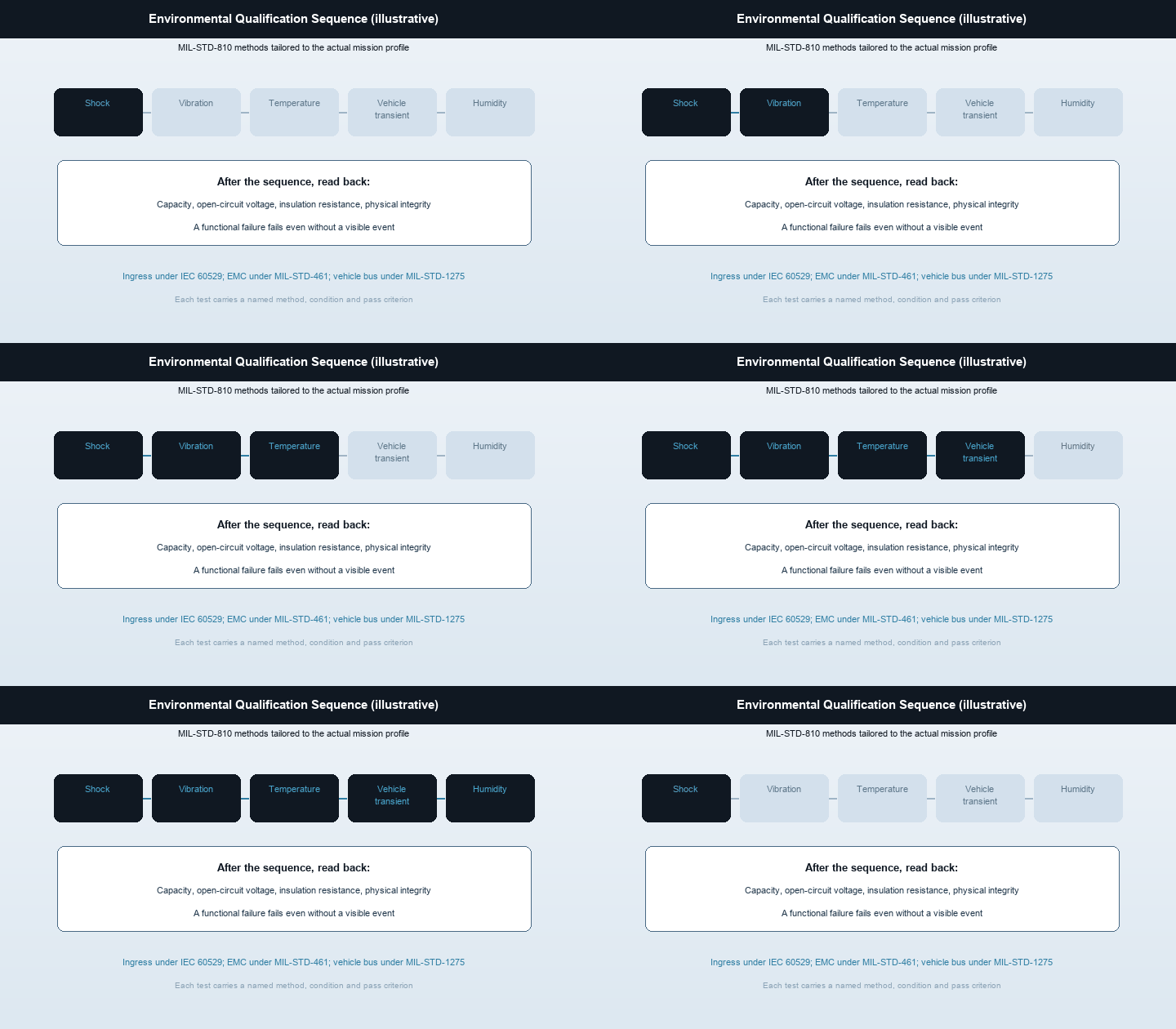
MIL-STD-810 is a tailoring process rather than a fixed checklist. The methods are selected and their levels set from the actual life-cycle profile, how the pack and the station peripherals are transported, stored and operated, so a garrison dock pack and a field training pack do not run the identical sequence. The common methods cover mechanical shock, including the handling and drop logic rugged equipment is built for, vibration across the transport profiles, high and low temperature and thermal shock, and humidity. For equipment used near fuels or munitions, the explosive-atmosphere method demonstrates that the unit does not ignite a defined flammable mixture, which is the relevant method for a pack carried in a vehicle or magazine environment.
The pass criterion is not merely that the pack survives the moment. After the environmental sequence the pack is read back for capacity, open-circuit voltage, insulation resistance and physical integrity, confirming it still functions rather than only that it did not rupture. A pack that shows a case crack, a lost capacity beyond the allowed limit or an insulation failure fails even if it completed the test without a visible event. The method levels and the read-back limits are recorded against the project so the result is auditable.
| Standard | What it covers | Role in this pack |
|---|---|---|
| MIL-STD-810 | Tailored environmental test methods | Shock, vibration, temperature, humidity |
| MIL-STD-461 | EMI emission and susceptibility | Control switching-charger noise near radios |
| MIL-STD-1275 | 28 V vehicle power and transients | Cranking, surge and spike survival |
| IEC 60529 | Ingress protection rating | Dust and water sealing |
A support pack or charger installed on a vehicle is connected to one of the harshest DC buses a piece of equipment will meet. MIL-STD-1275 defines the characteristics of the 28-volt DC power at the input terminals of utilization equipment, an interface standard distinct from the aircraft power standard and the shipboard one. The engine start collapses the bus toward cranking voltage, while load changes and alternator behaviour drive surges and fast high-voltage spikes. The current revision requires equipment to endure a high-voltage surge of about one hundred volts for fifty milliseconds and a lower surge for half a second, while operating continuously across roughly twenty to thirty-three volts.
Published reference designs show how the input is protected. A two-stage clamping circuit handles reverse polarity, voltage spikes and surges for a nominal load, suppressing the high-voltage surge and a much higher spike while protecting against a reverse connection, and holding the output at a nominal 28 volts with a defined maximum through the event. This matters for the support pack because a charger or dock mounted on the same vehicle has to survive the bus and keep the battery safe rather than passing the transient into the cells. The transient envelope is treated as an input-architecture requirement rather than a late qualification surprise.
Ingress protection is rated separately under IEC 60529, which defines the two-digit code for protection against solid objects and water. Station peripherals and docks are sealed according to where they are used, with handheld and portable stations commonly rated from IP44 through IP66 and remote nodes reaching IP67, and the rating is demonstrated in the enclosure test rather than inferred from a gasket. The support pack has to maintain its own sealing through the same dust and moisture exposure, particularly in a garrison dock or a solar-gateway buffer that sits outside a controlled room.
Electromagnetic compatibility matters because the pack and its charging electronics sit beside the station's data-link radio and sensitive receivers. The equipment-level requirement, MIL-STD-461, controls both the emissions the pack and its switching charger generate and their susceptibility to external fields, so a charging circuit does not introduce noise that the radio or a payload receiver would then pick up. The conducted and radiated limits are verified on the finished configuration, including the charger and cabling, and clean power design is treated as part of the system performance rather than only a compliance item.
The cells and packs are qualified to the nickel-specific standards, and the distinction from lithium is kept explicit. Performance is governed by IEC 61951-2, which defines the requirements and test methods for portable sealed nickel-metal hydride cells, including discharge, charge retention and endurance. Safety is governed by IEC 62133-1, the part of the sealed-cell safety standard that covers nickel systems, not the lithium part, and IEC 61959 covers the mechanical safety requirements for sealed portable cells. For industrial cells and packs, IEC 63115-2 provides the corresponding requirements. These standards define the abuse and safety tests, including the conditions under which the cell must vent safely rather than rupture.
The built-in protection is verified against these standards. The positive-temperature-coefficient element and the resettable fuse are tested under the defined fault and short conditions, and the venting path is confirmed to operate before the case fails. Because a sealed nickel cell contains no cadmium and no free liquid, the safety case is different from the older nickel-cadmium chemistry, which the manufacturer does not produce; a nickel-cadmium enquiry is directed to the nickel-metal hydride replacement. The honest cold limit is stated within the performance qualification, with a practical rechargeable field boundary around minus twenty degrees and controlled charging below that.
| Nickel standard | Scope |
|---|---|
| IEC 61951-2 | Performance of portable sealed NiMH cells |
| IEC 62133-1 | Safety of sealed nickel cells and packs |
| IEC 61959 | Mechanical safety of sealed portable cells |
| IEC 63115-2 | Industrial nickel cells and packs |
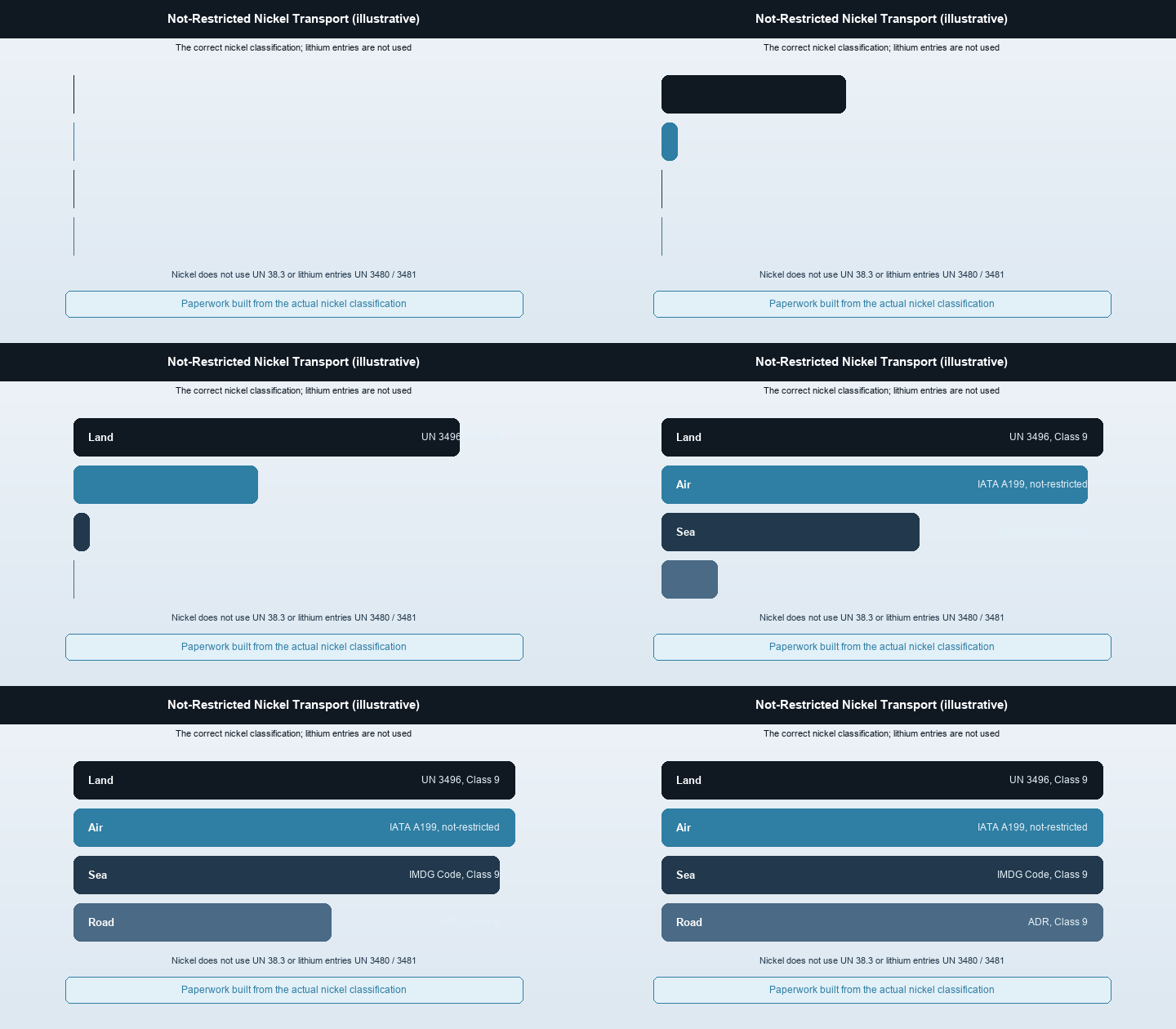
The transport classification is where nickel differs most clearly from lithium, and the correct entries are used. Sealed nickel-metal hydride cells and packs are carried under UN 3496, the miscellaneous dangerous-goods entry for nickel-metal hydride batteries, treated as a Class 9 entry for land transport under the appropriate regulation. For air, the IATA dangerous-goods rules carry the A199 special provision, under which properly described nickel batteries move not-restricted, avoiding the lithium handling and state-of-charge controls. Sea transport follows the IMDG Code and road transport the ADR, each with the corresponding Class 9 treatment.
Two negative statements are kept explicit to avoid misclassification. Nickel packs do not use UN 38.3, the test summary that applies to lithium cells, and they do not ship under the lithium entries UN 3480 or UN 3481; presenting them with lithium paperwork is an error even though the cells are rechargeable. The documentation is built from the actual nickel classification, with the correct proper shipping name and the packaging the provision requires, and the not-restricted air path is one of the genuine practical advantages for training and support equipment that is air-freighted back to a depot.
The acceptance logic is evidence-based across the whole qualification. Each test carries a named method, a defined condition and a pass criterion, the read-back after the environmental sequence confirms function rather than survival alone, and the transport paperwork is built from the actual nickel classification. No result is recorded without a measurement, and the honest limits, the cold boundary around minus twenty degrees and the lower energy density that keeps nickel in a support role, are stated rather than hidden. The scope is not stretched: the qualification covers the support-layer nickel packs for training, garrison and dock, AA/AAA and legacy and buffer equipment, while the station's lithium batteries are qualified and shipped under their own lithium standards and rules.
As a tailoring process. The methods and levels are chosen from the actual transport, storage and operating profile, covering shock, vibration, temperature, humidity and, where fuels or munitions are present, the explosive-atmosphere method. The pack is then read back for capacity, voltage and insulation, so a functional failure is caught even without a visible event.
Because the 28-volt vehicle bus collapses during cranking and produces surges and spikes, and the connected charger or dock must survive them and keep the cells safe. Published two-stage clamping designs suppress the high-voltage surge and spike and protect against reverse polarity while holding the output nominal.
The nickel-specific ones: IEC 61951-2 for performance, IEC 62133-1 for safety, IEC 61959 for mechanical safety and IEC 63115-2 for industrial cells. The PTC and fuse protection and the venting path are tested against these, and the lithium part of the safety standard is not used.
Under UN 3496 as a Class 9 entry for land transport, with the IATA A199 provision giving the not-restricted air path and the IMDG and ADR rules for sea and road. Nickel does not use UN 38.3 or the lithium entries UN 3480 and 3481, so lithium paperwork is not attached.
No. The practical rechargeable field boundary is around minus twenty degrees, with controlled charging below that and some capacity loss in the cold. It is stated within the performance qualification rather than claimed away, alongside the honest lower energy density that keeps nickel in a support and fixed-equipment role.
The qualification requirements draw on the named standards covering the tailored environmental methods of MIL-STD-810, the equipment-level EMI requirement MIL-STD-461, the vehicle power and transient interface MIL-STD-1275, and IEC 60529 ingress. The nickel safety and performance case uses IEC 61951-2, IEC 62133-1, IEC 61959 and IEC 63115-2, and transport follows UN 3496 with the IATA A199 not-restricted air path and the IMDG and ADR Class 9 rules. The station's lithium batteries follow their own lithium standards and transport entries, and no test result or statistic has been invented.
Weijiang Power supplies sealed NiMH cells and assembled NiMH packs for rechargeable operator training batteries, garrison and multi-bay chargers and docks, AA/AAA-compatible accessories and legacy gear and buffer packs in power-management and solar-gateway equipment, qualified to the nickel safety and performance standards and built to the field environmental and vehicle transient profile with PTC and resettable-fuse protection. The cells are qualified to IEC 61951-2 and IEC 62133-1 and the packs ship under UN 3496 with the not-restricted air path under IATA A199. We do not present NiMH as a station's internal battery, and we do not manufacture lithium-ion cells; lithium work is pack assembly only. Send us your mission profile, environmental, ingress and vehicle-bus requirements, capacity and insulation limits and transport destination, and we will work through the qualification plan and support the recorded evidence for your evaluation. See the Weijiang NiMH product range for standard pack formats, or contact our OEM team with the device specification and compliance requirements.


