Paper A sets out the split life of emergency luminaires - hot float years followed by a one to three hour discharge that cannot fail. Paper B turns that task into a cell selection decision: it compares nickel metal hydride (NiMH) with nickel-cadmium (NiCd), valve-regulated lead acid (VRLA) and lithium iron phosphate (LiFePO4), works with an ampere-hour budget for the evaluated period and describes a charge design that allows NiMH packs to reach four years of service under IEC 60598-2-22.
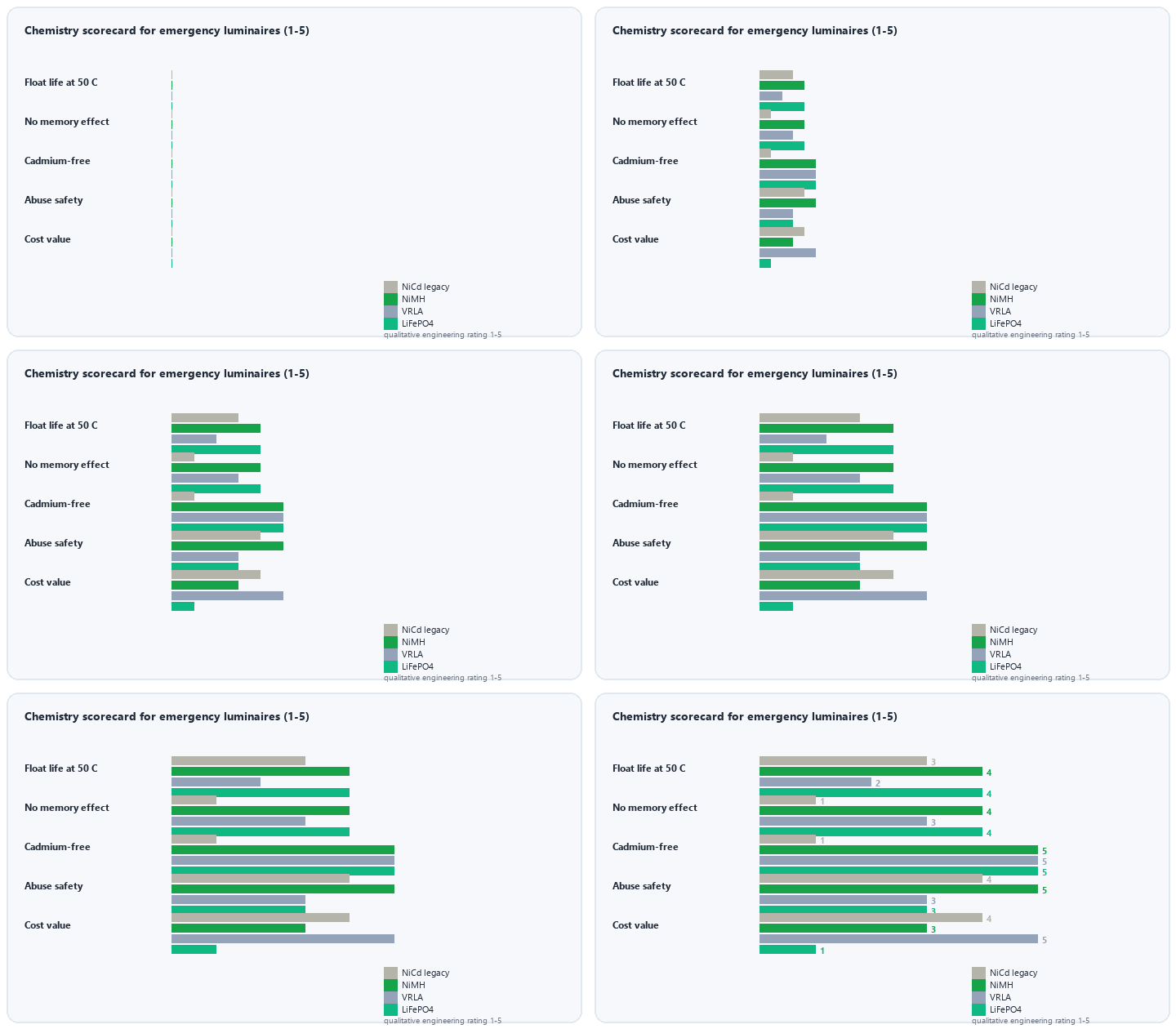
NiCd has defined emergency lighting for decades: it tolerates abuse, high temperature and overcharge, and delivers high current. The problem is regulation and electrochemistry. Cadmium is a RoHS-restricted heavy metal whose emergency lighting exemption has narrowed, forcing manufacturers toward documented cadmium-free designs; NiCd also exhibits a memory effect that shrinks the usable capacity after repeated shallow discharges of the monthly self-test, and its energy density is the lowest of the four. VRLA is cheap at larger capacity but heavy, temperature sensitive in float and - under recent Chinese emergency system regulations banning lead acid in self-contained equipment - increasingly excluded from this product class. LiFePO4 is durable and lightweight but requires protection circuitry, carries its own capacity cap in regulated systems and increases the cost of bill of materials for a device that spends most of its life idle. NiMH removes cadmium, eliminates the memory effect, roughly doubles the volumetric energy of NiCd, maintains the intrinsic safety of aqueous chemistry and does not require a complex management system. The animated scorecard rates all four of the five criteria that define float service; it is a qualitative engineering comparison.
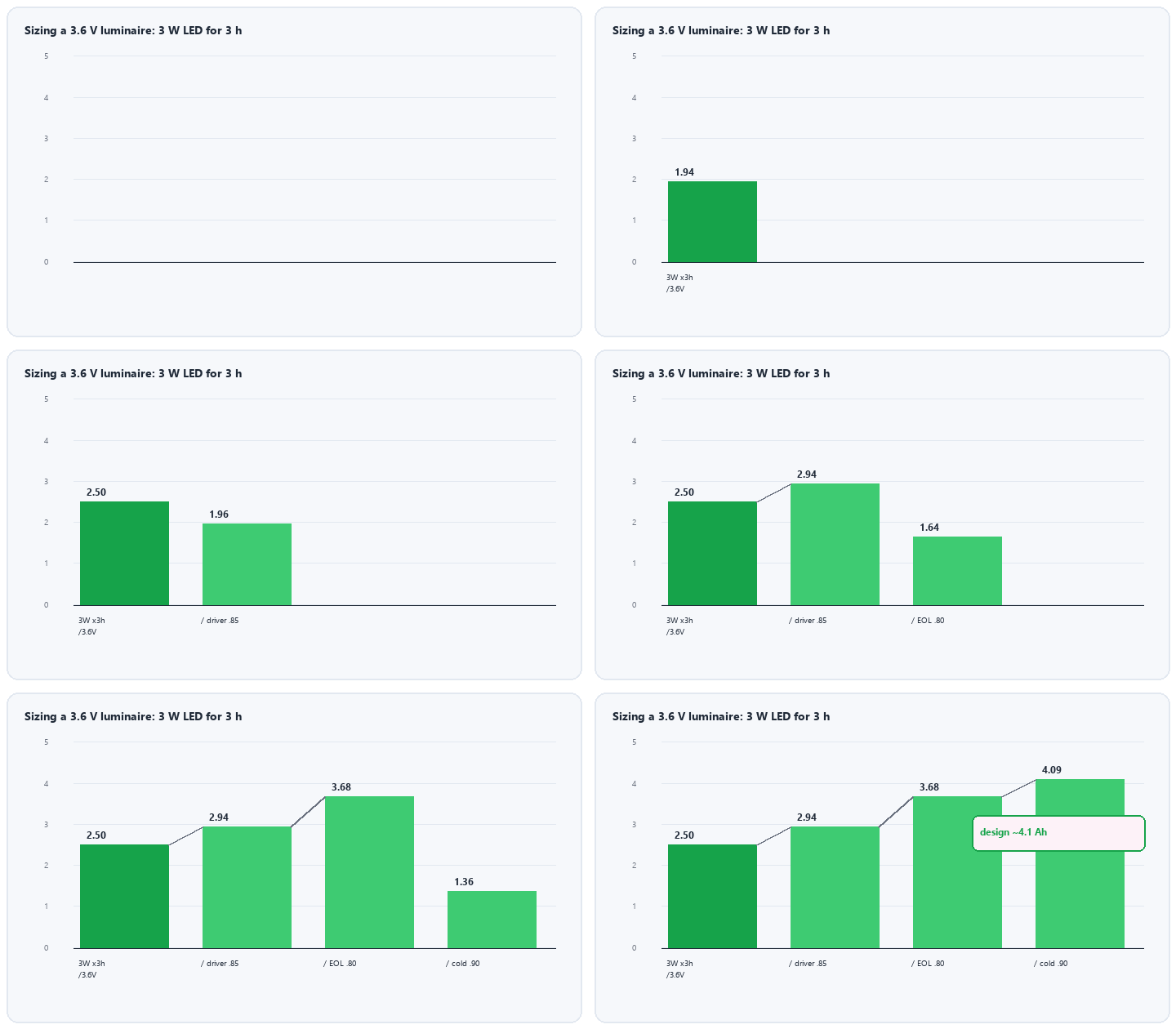
The energy target is the duration of the LED's emergency power rating divided by the driver efficiency and the nominal pack voltage, but the compliant pack is larger than that raw number for three reasons specific to emergency lighting. First, end-of-life capacity: IEC 60598-2-22 requires the installation to deliver its rated duration not only when new but after the declared service life (typically four years), so the design starts with about 20-25 percent headroom against fading capacity. Second, temperature: a cold corridor or stairwell in winter reduces the available capacity, while the same cell must survive on a hot ceiling in summer - the pack is sized for the cold case and charge-managed for the hot case. Third, the minimum input voltage of the LED driver: when the pack discharges the voltage drops, and the pack must still hold the driver beyond the dropout at the end of the rating period at the end of life. The animated walk-through applies this chain to a representative 3 W, three-hour, 3.6 V installation. The values are illustrative; formal declarations use measured driver efficiencies and cell curves.
NiMH achieves a four-year service only if the charger respects the chemistry’s aging characteristics. Overcharge is the enemy: once a sealed nickel cell reaches full charge, continued current is consumed by oxygen recombination, which releases heat, and the heat accelerates separator and electrolyte degradation in a self-reinforcing loop. Three disciplined regimes are used in emergency equipment: temperature-compensated trickle charge whose current decreases as the enclosure temperature increases; a pulse or timed recharge that fully charges and then rests, periodically recharging; and -dV/dt-terminated rapid recharge after an actual event or full self-test, followed by a low maintenance phase, as the EN standard requires a recharge within 24 hours. A thermistor tied to the string of cells allows the controller to cut back when the ceiling assembly heats up. With that design, NiMH float life in a controlled 35-40 °C enclosure reliably reaches the four-year horizon; without it, no chemical selection can save the product.
The 1-6 W emergency LED load is neatly mapped onto three to six series NiMH cells (nominal 3.6-7.2 V) in AA, C or sub-C format, with capacity selected from a duration ladder. Cells are welded into matching strings - capacity and resistance in binning are important because the weakest cell sets the end-of-duration voltage - and fitted with thermal protection and, on higher current designs, resettable devices or fuses. A practical advantage over NiCd appears in the self-test regime: because NiMH does not produce voltage depression from repeated shallow cycles, the monthly function test does not gradually reduce the apparent capacity measured by the annual full-term test, eliminating the periodic conditioning cycle required by the NiCd fleet. Pack markings carry chemistry, nominal capacity, date of manufacture and replacement guidance, which is increasingly important for battery removability requirements and European battery labeling regulations.
Emergency batteries are wear items in installations that last a decade or more, so removable, lockable battery compartments and tool-operated release extend the life of luminaire compliance and align with manufacturer responsibility regulations that prioritize removable and replaceable batteries. Choosing NiMH also simplifies the end-of-life story for European buyers: no cadmium, designated nickel recycling routes, and UN 3496 Class 9 transport instead of lithium controls. Paper C sets out proof of the type tests - rated-duration discharge, transition, high temperature resistance, self-test compatibility and cell safety - which convert these design options into certified luminaires.
Weijiang power supplies high-temperature NiMH cells and matched welded strings for self-contained emergency luminaires across 1-3 hour duration ladders, with float charge recommendations tuned to ceiling ambient profiles, removable pack design support and IEC 61951-2, IEC 62133-1 and UN 38.3 documentation. Send us your emergency LED wattage, rated duration, worst enclosure temperature and target service life and we'll size a cadmium-free pack that meets its rating in year four, not just on factory testing.


