Paper B guides the battery decision across portable concentrators and mesh nebulizers: where lithium-ion genuinely wins, where NiMH is the better engineering choice, how to size from a flow-setting table or a piezo wattage, and how aircraft and safety constraints shape the pack.
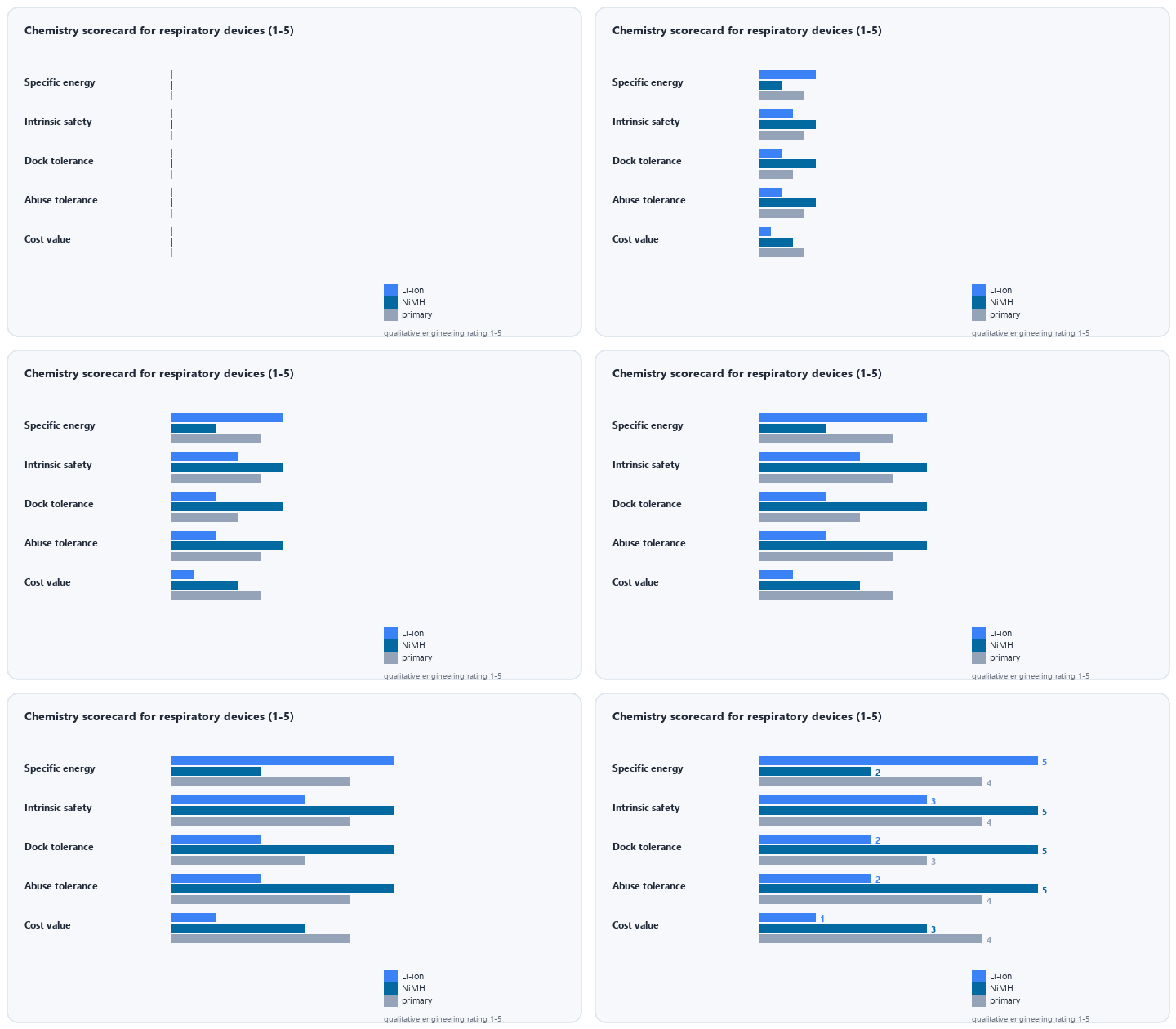
For wearable POCs carried all day, lithium-ion's specific energy is decisive: commercial packs are commonly 8–12-cell lithium configurations around 14.4 V and 6.7 Ah, precisely to clear a multi-hour flight, at the cost of a BMS and the flammability-management burden of an organic electrolyte. For stationary/home concentrator backup and for mesh nebulizers, NiMH is rational: the load is only 0.6–2 W, two AA cells suffice for multi-hour treatments (a 1.2 W mesh nebulizer runs about 4 hours on two AAs), weight is irrelevant on a bedside table, and the aqueous chemistry removes thermal-runaway concern in a home setting. NiMH also tolerates the "used briefly, re-docked" pattern of nebulizer treatment without the calendar stress of a lithium cell held full at warmth.
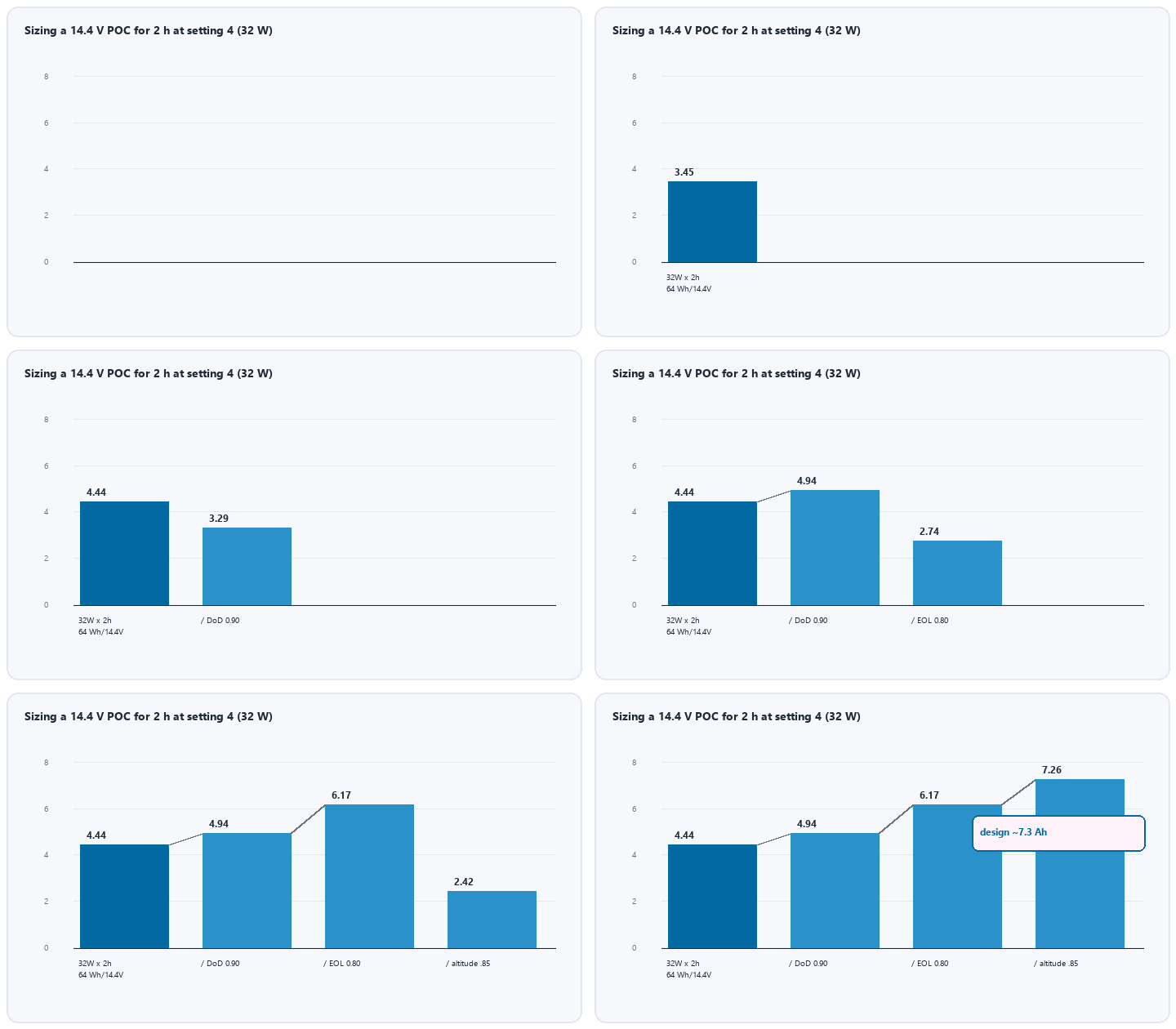
Size to the setting the clinical claim requires, not the easiest one. If the target is 2.5 hours at setting 4 and measured consumption there is 32 W average, energy demand is 80 Wh; on a 14.4 V rail that is about 5.6 Ah raw, and depth-of-discharge (0.9 for lithium, 0.85 for NiMH), end-of-life fade (0.8) and an altitude/heat margin (0.85) push the design capacity higher — which is exactly why flagship POCs carry 6.7 Ah-class packs and still quote their longest runtime only at setting 1. Pulse-dose mode lowers duty cycle and must be modelled from the patient's actual breath rate rather than assumed.
The nebulizer calculation is simpler and a natural NiMH design: at 1.2 W from a 2.4 V (2-cell) rail, average current is 0.5 A; a 15-minute treatment three times a day consumes under 0.4 Ah per day, so two 2000 mAh NiMH AA cells support weeks of treatments between charges, and low-self-discharge cells keep a docked unit ready. Operating-cycle limits (e.g. 20 min on / 20 min off) protect the piezo and define the thermal envelope the pack is sized within.
Transit-operable POCs must satisfy airline use rules: spare uninstalled lithium packs are capped around 100 Wh (up to 160 Wh with operator approval), which bounds pack design and labelling; installed batteries and NiMH face simpler regimes. Watt-hour marking, UN 38.3 evidence and FAA-aligned documentation are therefore part of battery design, not afterthoughts.
Weijiang Power supplies NiMH AA/AAA cells and custom welded packs for respiratory OEMs, with matched cells, NTC charge supervision, IEC 62133-1 and UN 38.3 documentation. Send your flow-setting power table or piezo load and runtime target and we will size a pack that meets the claim honestly across settings.


